
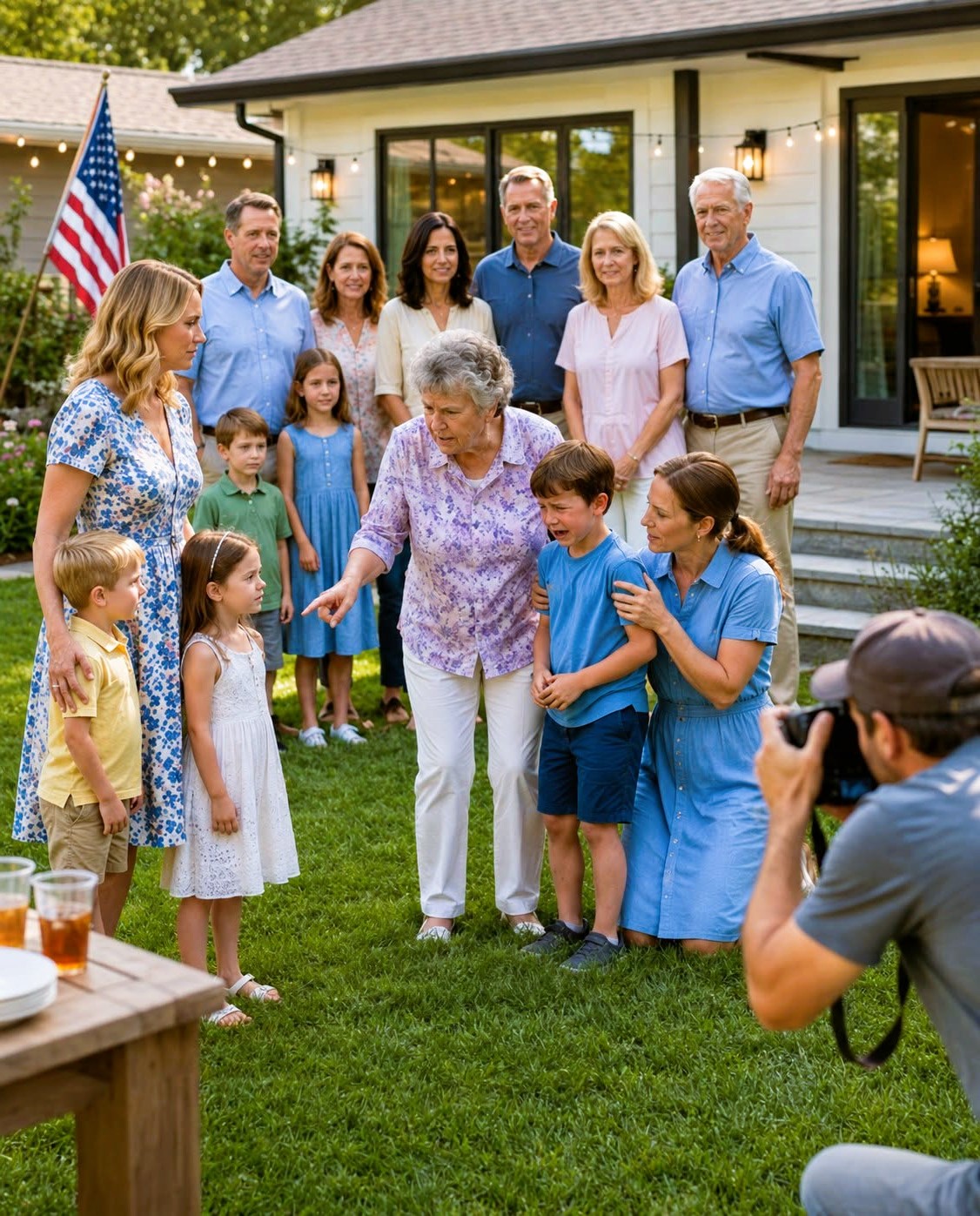
She looked annoyed when she saw Emma.
“I thought this was private.”
“Noah asked for Aunt Emma.”
Mom sighed.
Then she sat across from him at a picnic table.
“Well.”
Silence.
Noah looked at me.
Mom finally said, “I’m sorry you got upset at the family gathering.”
I closed my eyes.
There it was.
Not I’m sorry I hurt you.
I’m sorry you got upset.
Noah noticed too.
“You said I was ruining everybody’s day.”
Mom shifted.
“I was frustrated.”
“You pulled me.”
“I was trying to move you.”
“You didn’t want me in the picture.”
She looked at me.
I said nothing.
This was his conversation.
Mom sighed.
“I wanted one photograph where everyone looked happy.”
“Was I not family?”
The question seemed to irritate her.
“I never said that.”
“You took pictures without me.”
Her head snapped toward Emma.
“You’ve been filling his head with things.”
“No,” Emma said. “He asked you a question.”
Mom looked back at Noah.
“You are my grandson.”
“Then why didn’t you want me there?”
“I already explained.”
“No, you didn’t.”
His voice trembled, but he kept going.
“You said I make pictures bad.”
Mom’s expression changed.
For the first time, she seemed to realize an eight-year-old could remember exact words.
Could ask follow-up questions.
Could refuse the version of events adults offered him.
“I shouldn’t have said that.”
Noah waited.
Mom swallowed.
“I’m sorry.”
He stared at her.
“For what?”
I almost cried.
My son was asking for the thing I had never known how to ask for.
Specific accountability.
Mom looked cornered.
Then something unexpected happened.
Her shoulders dropped.
“I’m sorry I planned the picture without you.”
Noah listened.
“I’m sorry I sent messages about keeping you away from photographs.”
Emma looked at me.
Mom continued slowly.
“I’m sorry I grabbed your shoulder. And I’m sorry I told you that you were ruining the day.”
Noah’s eyes filled.
“Why don’t you like me?”
My mother’s face broke.
It happened so quickly that I almost missed it.
The irritation disappeared.
Something frightened replaced it.
“I do like you.”
“You like Lily more.”
Mom opened her mouth.
Then closed it.
“I have treated Lily differently.”
“Why?”
“I don’t know.”
It was the first honest thing I had heard from her.
Maybe she truly did not know.
Or maybe she did not yet know how to explain it.
Noah looked down.
“Am I allowed in pictures now?”
My mother covered her mouth.
“Yes.”
He shook his head.
“I don’t want to be if you have to let me.”
That sentence destroyed whatever defenses she had left.
Mom began crying.
Not dramatically.
No accusations.
No angry demands.
Just quiet tears.
Noah looked at me uncertainly.
“You don’t have to comfort her,” I told him.
Mom nodded.
“Your mom is right.”
She wiped her face.
“You don’t.”
Then she said something I had never heard her say in my entire life.
“I was wrong.”
Noah did not forgive her that day.
I was glad.
Forgiveness should never be a performance children are forced to give adults because the adult finally said the correct words.
We went home.
For the next month, Mom stayed away.
She sent Noah one letter.
Not a gift.
Not money.
A letter.
She wrote that she was sorry she had made him feel like he had to earn his place in the family.
She told him he did not have to answer.
He put the letter in his desk.
Two weeks later, he drew a picture.
It showed all the cousins standing together.
Grandma was far off to one side.
I asked what it meant.
“She’s not ready yet.”
I nearly smiled.
Kids understand boundaries better than adults sometimes.
Summer turned into fall.
For the first time in years, we stopped organizing our lives around keeping Mom happy.
Emma hosted Sunday dinners.
Daniel began coming regularly.
Sometimes things were awkward.
Sometimes Noah ignored him.
Daniel accepted that.
Once, when Noah asked Daniel to help build a model airplane, my brother looked like he had been handed something precious.
Trust returned slowly.
Mom began seeing a therapist.
Emma told me because Mom had given her permission to share it.
Apparently, during one session, Mom had admitted that she had always divided people into roles.
The successful child.
The difficult child.
The charming grandchild.
The sensitive grandchild.
Once she assigned someone a role, she interpreted everything they did through it.
Noah had been labeled difficult before he was old enough to understand the word.
Why?
Because he reminded her of me.
That revelation hurt.
But it also freed me from a question I had carried since childhood.
There had never been something uniquely wrong with me.
My mother had created a version of me in her head, and I had spent decades trying to prove that imaginary girl did not exist.
Noah would not inherit that job.
Three months after the backyard incident, Mom asked if she could attend Noah’s school science fair.
I asked him.
He thought for a long time.
“She can come.”
“Are you sure?”
“Yes.”
“But?”
He looked at me.
“She can’t tell me where to stand.”
I smiled.
“I think that’s reasonable.”
Mom came.
She stood quietly behind the other parents.
Noah had built a miniature water filtration system.
He explained every step.
Mom listened.
When he finished, she did not correct him.
She did not tell him to smile.
She did not compare him to anyone.
She simply said, “You worked hard on this.”
Noah shrugged.
“I like science.”
“I can tell.”
That was all.
It was small.
But sometimes repair starts small.
At Christmas, Emma hosted.
Mom was invited for two hours.
No one knew whether she would come.
She arrived carrying a plain bag of cookies.
No dramatic presents.
No speeches.
When it was time for photographs, something remarkable happened.
Nobody organized the children.
Nobody told them where to stand.
The cousins piled together naturally in front of the Christmas tree.
Lily pulled Noah into the middle.
Mason stood beside him.
Daniel’s daughters squeezed in.
The youngest cousin sat cross-legged on the floor.
Emma raised her phone.
Mom stood near the kitchen doorway.
Then Noah looked at her.
“Grandma?”
She froze.
“Would you take the picture?”
Her eyes filled.
“Are you sure?”
He nodded.
Mom took the phone.
She lifted it.
Then lowered it again.
“There’s one problem.”
Everyone went quiet.
For half a second, I felt the old fear.
Then Mom looked at me.
“I’m not in it.”
Emma smiled.
“I’ll take it.”
Mom hesitated.
Noah walked over.
He took her hand.
“You can stand by me.”
My mother looked down at him.
“Only if you want me there.”
“I do.”
Emma took the picture.
Nobody was centered perfectly.
Mason was blinking.
Daniel’s youngest daughter was laughing.
My hair looked terrible.
Mom’s eyes were red.
Noah was not smiling directly at the camera because he was looking sideways at Lily.
It was not a perfect photograph.
It became my favorite one.
Several weeks later, Mom gave every family member a printed copy.
There were no cropped versions.
No secret photographs.
No preferred arrangement.
Just one messy picture of people learning how to become a family again.
Not everyone changed.
Aunt Patricia still thought I had overreacted.
Two cousins eventually stopped attending gatherings because they said the atmosphere had become “too serious.”
I let them go.
That was another lesson I learned.
Healing a family does not always mean keeping every person in it.
Sometimes healing means refusing to preserve relationships that depend on one person swallowing all the pain.
Daniel and I never became as close as we had been before.
But we became more honest.
He stopped making jokes when he was uncomfortable.
I stopped pretending they did not bother me.
Emma and I became closer than we had ever been.
One night, almost a year after the backyard photograph, she sat beside me on my porch.
“I still feel guilty,” she said.
“For what?”
“Not speaking sooner.”
I looked through the window.
Noah and her children were playing a board game at the kitchen table.
“You did speak.”
“Eventually.”
“Yes.”
“I should have done it the first time.”
“Probably.”
She laughed softly.
“Thanks.”
“I’m not going to lie to make you feel better.”
“I know.”
I nudged her shoulder.
“But when it mattered most, you took your children out of that picture.”
Emma looked inside at Noah.
“I keep thinking about what would have happened if I hadn’t.”
I knew.
He would have left believing everyone agreed with Grandma.
Instead, he remembered something else.
His aunt stepping forward.
His cousins leaving the photograph.
Lily taking his hand.
Mason standing beside him.
Sometimes one person’s cruelty teaches a child that they are unwanted.
But one person’s courage can interrupt that lesson before it becomes permanent.
The next summer, Mom asked whether we wanted another family gathering.
Her message was careful.
No pressure. No photographer. Everyone invited at the same time.
I showed Noah.
“What do you think?”
He grinned.
“Can we have water balloons?”
I laughed.
“I’ll ask.”
Mom agreed.
The gathering was smaller than the previous year.
No rented canopy.
No professional photographer.
No elaborate decorations.
Just burgers on the grill, children running barefoot across the grass, music from someone’s phone, and a plastic tub filled with water balloons.
At one point, I realized Mom had disappeared.
Old instincts stirred.
I looked toward the house.
Then I saw her.
She was sitting on the back steps while Noah explained something about a bug he had found in the garden.
She was listening.
Actually listening.
He held out the bug container.
Mom leaned closer.
A year earlier, she would have complained about dirt.
Instead, she asked, “What kind is it?”
Noah launched into a long explanation.
She stayed there until he finished.
Later that afternoon, Emma pulled out her phone.
“Everybody together.”
Noah groaned.
“Do we have to?”
We all laughed.
Mom looked at him.
“No.”
Everyone stopped.
She smiled slightly.
“You never have to be in a picture you don’t want to be in.”
Noah considered that.
Then he ran toward the group.
“I want to.”
We gathered beneath the same maple tree.
The same place where he had cried a year earlier.
Nobody mentioned it.
We did not need to.
Noah stood exactly where he chose.
Right in the middle.
Mom stood behind him.
Just before Emma took the picture, Noah reached up and grabbed her hand.
Click.
That photograph sits in our living room now.
Not because everyone looks perfect.
We don’t.
It matters because every person in the frame is there by choice.
Every person belongs.
And whenever I look at it, I remember the moment my son asked a question no child should ever have to ask.
“Did I do something wrong, Grandma?”
The answer was always no.
He had done nothing wrong.
His only mistake had been assuming that adults automatically knew how to love children fairly.
Sometimes they don’t.
Sometimes families repeat old wounds until someone becomes brave enough to stop pretending those wounds are traditions.
My sister did that when she removed her own children from the photograph.
Noah did it when he refused to accept a fake apology.
And eventually, I did it when I stopped protecting my mother from the consequences of her own choices.
We did not save the family by keeping the peace.
We saved the parts worth saving by finally telling the truth.
And my son never again had to ask whether he belonged.
He knew.
💬THE END! THANK YOU FOR READING! ❤️🙏