
 Reading Time: 16 minutes
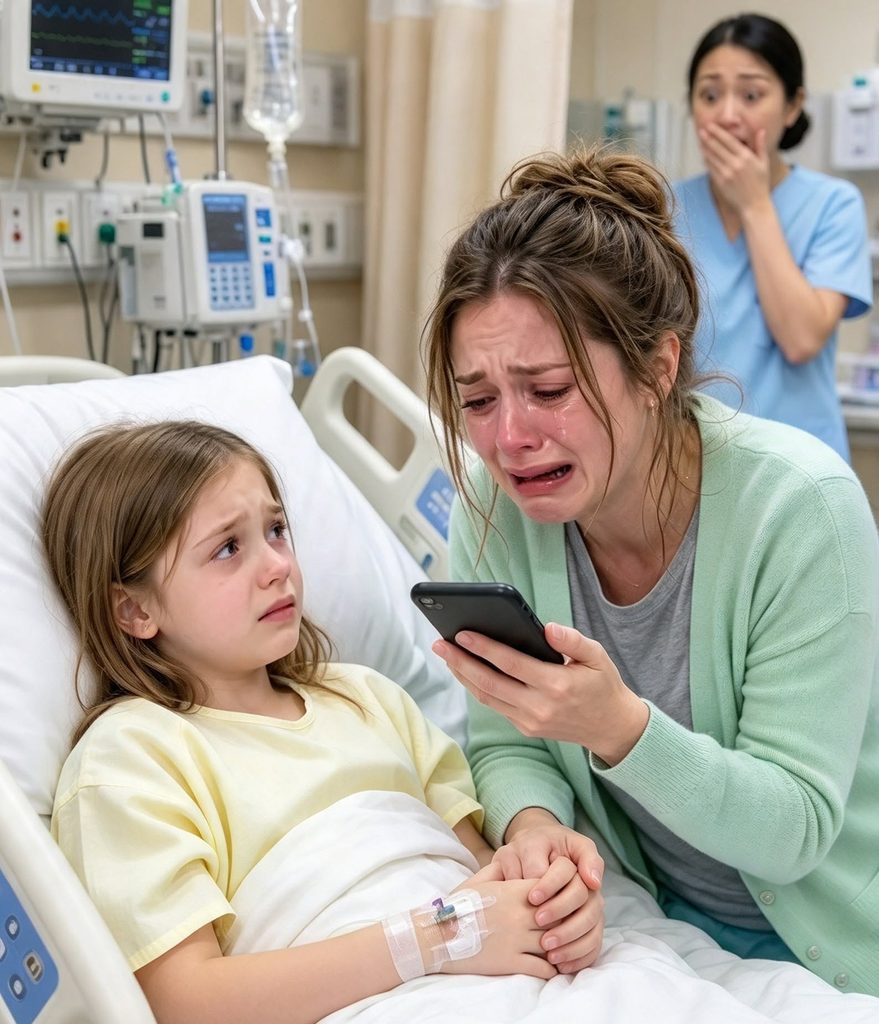
PART 3: MY DAUGHTER WAS FIGHTING FOR HER LIFE WHILE MY HUSBAND AND MOTHER-IN-LAW WERE SECRETLY SELLING OUR HOME — BUT ONE PHONE CALL EXPOSED EVERYTHING
Barbara’s voice filled the hospital room.
“I’m giving you one last chance to come home, Amanda. If you’re not standing in my kitchen by five o’clock, don’t expect that house to belong to you anymore.”
I stared at Detective Reynolds.
He raised one finger to his lips, signaling me to remain calm.
“What exactly do you mean by that, Barbara?” I asked.
She gave a sharp, humorless laugh.
“You’ve always been slow to understand how things work in this family.”
“Then explain it to me.”
“The house, Amanda. The house you’ve been so proud of. Andrew finally understands that you don’t deserve to control everything.”
My stomach twisted.
Eight years of marriage.
Eight years of Christmas mornings, school photographs, birthday cakes, and bedtime stories.
And somewhere inside those eight years, my husband had apparently decided that stealing my home was easier than leaving me.
“Andrew told me the house was ours,” I said carefully.
Barbara snorted.
“Andrew tells you whatever keeps you quiet.”
Across the room, Detective Reynolds wrote something in his notebook.
I forced myself to continue.
“And what happens if I don’t come home?”
“Then you’ll find yourself with nowhere to take that little girl when the hospital finally sends her home.”
I closed my eyes.
That little girl.
She was talking about Katie, my daughter, who was lying unconscious just hours earlier.
“Barbara,” I whispered, “Katie almost died.”
“And yet she’s still alive, isn’t she?”
The silence that followed seemed to swallow the entire room.
Detective Reynolds slowly lowered his pen.
Then Barbara said something that made him look directly at me.
“Andrew already took care of the necessary paperwork. All you have to do is cooperate.”
“What paperwork?”
“Don’t play stupid.”
“Barbara, I’m asking you.”
Her voice hardened.
“The papers that make sure this family gets what it deserves.”
The detective motioned for me to end the call.
“I need to check on Katie,” I said.
Barbara hissed.
“Five o’clock, Amanda. Don’t test me.”
The call disconnected.
For several seconds, nobody spoke.
Then Detective Reynolds turned toward me.
“Mrs. Miller, I need you to understand something. Your husband and his mother may be involved in a crime far more serious than a forged signature.”
I looked toward Katie’s bed.
“What could possibly be worse?”
He glanced at the paperwork in his hands.
“Someone may have tried to make sure your daughter couldn’t tell us what she saw.”
My knees nearly gave way.
The House My Father Left Me
To understand what happened next, you need to understand something about my house.
It wasn’t simply a piece of property.
It was the last thing my father had given me before he died.
He had bought the little two-story home outside Columbus, Ohio, when I was nineteen. He spent years repairing it himself, replacing windows, sanding floors, and building the wooden porch where Katie learned to ride her first bicycle.
When cancer took him twelve years later, he left the house to me.
Only me.
His will was very specific.
He said he wanted his daughter to have a place where nobody could ever make her feel unwelcome.
I never imagined the man I married would be the person who tried to take that promise away.
Andrew moved into the house after our wedding.
He helped with expenses, bought furniture, and paid for improvements, but the deed remained in my name.
Barbara hated that.
She never said it directly at first.
Instead, she made little remarks during Sunday dinners.
“A married woman shouldn’t keep property separate from her husband.”
Or:
“A real wife trusts her husband with everything.”
Once, when Katie was six, Barbara looked around my dining room and said, “Andrew deserves something better than living in a house another man gave you.”
I told myself she was simply old-fashioned.
I told myself Andrew loved me.
I told myself that families sometimes disagreed about money.
But looking back, I could see the pattern.
Barbara wasn’t offended by my independence.
She was planning how to destroy it.
And Andrew had been helping her.
Detective Reynolds spread several documents across the small consultation-room table.
One was a copy of the forged power of attorney.
Another was a preliminary property-sale agreement.
The third was a financial statement listing a sale price of $385,000.
My throat tightened.
“That’s my house.”
He nodded.
“The buyer is a company called Westbridge Property Holdings.”
“Who owns it?”
“We’re investigating that.”
I studied the signature again.
It looked like mine at first glance.
But the final letter curved the wrong way.
My father had taught me to sign my name when I was seven. He’d always told me to finish the last stroke firmly.
Andrew knew that.
Apparently, he hadn’t practiced enough.
“Can they actually sell my house with this?” I asked.
“The transaction hasn’t closed,” Reynolds replied. “And we’re taking steps to alert the appropriate parties that the document is disputed.”
For the first time since the accident, I felt something other than terror.
A tiny spark of relief.
Then Reynolds slid a photograph across the table.
It showed Andrew standing beside a black SUV.
The timestamp was from Tuesday afternoon.
Twenty-three minutes before Katie was hit.
“Do you recognize this vehicle?”
I shook my head.
“Andrew drives a silver truck.”
“We know.”
“Then whose car is that?”
The detective hesitated.
“We believe it’s connected to a vehicle seen near the collision.”
My skin turned cold.
The Secret Katie Overheard
When I returned to the ICU, Katie was awake.
Her face looked pale against the white pillow, and there were purple shadows beneath her eyes.
She smiled weakly when she saw me.
“Mommy.”
I hurried to her bedside.
“I’m here, sweetheart.”
She reached for my hand.
“Is Andrew coming?”
I froze.
Before Tuesday, she had called him Dad.
He wasn’t her biological father. Katie was two when I married him, but for eight years he had been the man who attended her school performances, carried her on his shoulders, and taught her how to throw a baseball.
Hearing his first name instead of Dad felt like losing another part of our family.
“No, honey,” I said. “He’s not coming.”
Katie nodded.
Then tears gathered in her eyes.
“I heard them.”
“Who?”
“Andrew and Grandma Barbara.”
I pulled my chair closer.
“Tell me what happened.”
Katie looked toward the door.
“Are they going to be mad?”
Something inside me broke.
My injured daughter was lying in intensive care, frightened that the people who had hurt her would be angry if she spoke.
“No one is allowed to hurt you for telling the truth,” I whispered.
She swallowed.
“Monday night, I came downstairs because I wanted water.”
I remembered that night.
Andrew had told me he was working late in the garage.
Barbara had supposedly stopped by to borrow a serving dish.
Katie continued.
“They were in the dining room. Grandma said you would never sign the papers.”
My fingers tightened around hers.
“What papers?”
“The house papers.”
I felt my pulse pounding in my ears.
“Then Andrew said he already had your signature.”
Katie paused, breathing carefully.
“And Grandma said they needed the money before Friday.”
“Did they say why?”
Katie nodded.
“Grandma said someone was going to take her house.”
I stared at her.
Barbara owned a beautiful four-bedroom home in an expensive neighborhood.
She drove a luxury car.
She wore jewelry that cost more than my monthly salary.
For years, she had behaved as though everyone around her was financially beneath her.
Was she losing everything?
Katie continued.
“I dropped my water bottle. Andrew saw me.”
My heart sank.
“What happened?”
“He asked how much I heard.”
I could barely breathe.
“I told him I didn’t hear anything.”
“And then?”
“He smiled.”
Katie began crying.
“He said good girls keep family secrets.”
I leaned forward and gently brushed the hair away from her forehead.
“Oh, sweetheart.”
“The next day, when I was walking to gymnastics, I saw him.”
“Where?”
“Near the crosswalk.”
I pressed the nurse-call button before asking anything else.
Katie had already told the detective that Andrew pushed her. I didn’t want to overwhelm her with questions or risk influencing her account.
But she looked at me and whispered one more sentence.
“Mom, he knew I was going to tell you.”
The Birthday Dinner That Never Happened
At 4:35 that afternoon, my phone rang.
Andrew.
I didn’t answer.
He called again.
Then he sent a message.
Mom is upset. This has gone far enough. Just come home and apologize.
I stared at the screen.
My daughter had been hit by a car.
A fraudulent legal document had been prepared using my name.
And somehow, in Andrew’s mind, the biggest problem was that his mother hadn’t received an apology.
Another message appeared.
You don’t understand what’s at stake.
I forwarded the messages to Detective Reynolds.
Five minutes later, he called.
“Don’t respond to him, Amanda.”
“Have you found anything?”
“We’ve confirmed something important about the SUV.”
I stood beside the ICU window.
“What?”
“It was rented using Andrew’s driver’s license.”
My stomach dropped.
“Then he was driving?”
“We’re still establishing who was behind the wheel when Katie was struck. But we have evidence connecting him to the rental.”
I gripped the windowsill.
“She said he pushed her.”
“I know.”
“He pushed my daughter toward the road.”
“We’re investigating exactly what happened.”
His careful words were infuriating, but I understood why he used them.
He couldn’t accuse someone without evidence.
I wasn’t a detective.
I was a mother who had spent the previous thirty-six hours wondering whether her child would survive.
“What happens now?” I asked.
“We’re executing search warrants.”
“At my house?”
“At several locations.”
I looked at the clock.
Barbara’s birthday guests would be arriving soon.
For a brief moment, I pictured her dining room.
The expensive candles.
The polished silverware.
The elaborate floral centerpiece she insisted on ordering every year.
And the empty space where she expected me to stand, wearing an apron and serving her friends.
I wondered whether she had any idea who would arrive at her front door instead.
What the Police Found
The first call came at 6:12 p.m.
Detective Reynolds sounded different.
More urgent.
“Amanda, are you somewhere private?”
I stepped into the consultation room.
“Yes.”
“We found financial records at Barbara’s residence.”
I waited.
“She has significant debts. Her home is in foreclosure proceedings, and there are multiple outstanding loans.”
I closed my eyes.
Katie had heard correctly.
Barbara was losing her house.
“How much?”
“Well over four hundred thousand dollars.”
I sat down.
That explained the desperation.
But not the cruelty.
“Was Andrew helping her?”
“We believe he was attempting to obtain money from the sale of your property.”
I thought about all the times I’d offered Barbara financial help.
The groceries I’d bought when she claimed her credit card wasn’t working.
The utility bills I’d quietly paid.
The expensive birthday dinners.
She had smiled while accepting everything.
And behind my back, she had been planning to steal the one possession my father left me.
“There’s more,” Reynolds said.
I pressed a hand against my chest.
“What?”
“We found a digital copy of the power of attorney on Andrew’s laptop, including earlier drafts.”
I stared at the wall.
“Earlier drafts?”
“Several versions. Different signatures. Different dates.”
My husband had practiced forging my signature.
Not once.
Not in a moment of panic.
Repeatedly.
Carefully.
Methodically.
“Was Barbara involved?”
“We found messages between them discussing the document and the sale.”
I covered my mouth.
Then Reynolds said the words that finally made me cry.
“Amanda, one message specifically mentions Katie.”
The room seemed to tilt.
“What does it say?”
He paused.
“I can’t read you the entire exchange right now. But Andrew wrote that Katie had heard too much, and Barbara replied that the situation needed to be handled before she told you.”
I couldn’t speak.
My daughter wasn’t collateral damage in a financial dispute.
She had become an obstacle.
And the people she called family had decided to remove it.
The Video From the Gas Station
The next morning, Detective Reynolds returned to the hospital carrying a tablet.
He asked me to sit.
I hated that request.
Every time someone asked me to sit, it meant another piece of my life was about to collapse.
“We recovered additional surveillance footage,” he said.
My mouth went dry.
“From the accident?”
“From a gas station near the intersection.”
He explained what investigators had established.
The camera showed Katie walking along the sidewalk shortly before the collision.
A black SUV pulled into a nearby parking area.
A man stepped out.
Andrew.
I could see him clearly.
The same jacket he’d worn at breakfast.
The same baseball cap Katie had given him for Father’s Day.
For a moment, he stood beside the vehicle, watching the sidewalk.
Then he walked toward her.
The camera couldn’t capture the entire encounter because part of the sidewalk was hidden behind a delivery truck.
But it showed enough.
Katie saw Andrew.
She stopped.
He approached.
They appeared to argue.
Then they moved beyond the camera’s direct view.
Seconds later, Katie stumbled backward into the street.
The collision happened almost immediately.
I made a sound I didn’t recognize.
Detective Reynolds stopped the video.
“I’m sorry, Amanda.”
I shook my head.
“Play it again.”
“Amanda—”
“Please.”
He hesitated, then replayed the footage.
I watched Andrew approach my daughter.
Watched her back away.
Watched the sudden movement that sent her into the road.
And then I noticed something.
“Stop.”
He paused.
“Go back three seconds.”
He did.
I pointed at the screen.
“Look at his hand.”
Andrew had reached toward Katie.
The angle wasn’t clear enough to show the full movement, but his arm extended sharply just before she stumbled.
“He pushed her,” I whispered.
Reynolds nodded slowly.
“Her statement is consistent with what we’re seeing.”
Then he showed me another camera angle.
This one captured Andrew returning to the SUV.
He didn’t run toward Katie.
He didn’t call for help.
He didn’t even look back for more than a moment.
He got into the vehicle and drove away.
I felt something inside me turn to stone.
For eight years, I’d trusted that man to protect my child.
He had watched her fall into the road.
And he had left her there.
Barbara’s Last Performance
By Thursday afternoon, the police had arrested Andrew.
I learned about it from Detective Reynolds, not from my husband.
He was being questioned in connection with Katie’s injuries and the suspected financial crimes.
Investigators were still working to establish every detail of the collision and each person’s involvement.
But the evidence against him had become impossible to ignore.
Barbara, however, still seemed convinced she could talk her way out of everything.
She called me at 2:17 p.m.
I answered only after speaking with the detective.
Her voice was trembling.
“Amanda, you need to fix this.”
I looked toward Katie, who was sleeping peacefully for the first time in days.
“Fix what?”
“Andrew has been arrested!”
“I know.”
“Then why are you standing around doing nothing?”
My hands were perfectly steady.
A strange thing happens when fear finally turns into certainty.
You stop searching for explanations from people who have spent years lying to you.
“What would you like me to do, Barbara?”
“Tell the police this is a misunderstanding!”
“Is it?”
“Of course it is!”
“Did you know Andrew forged my signature?”
Silence.
“Did you know he was trying to sell my father’s house?”
Nothing.
“And did you know Katie overheard your conversation?”
Her breathing changed.
“Amanda, you’re not understanding the situation.”
“Then explain it.”
“You have a home. You have a job. You have savings. I was about to lose everything.”
I closed my eyes.
There it was.
Not an apology.
Not concern for Katie.
An explanation for why she thought she deserved what belonged to me.
“You were willing to take my daughter’s home.”
“Andrew said he could arrange everything legally.”
“But you knew I hadn’t agreed.”
Barbara began crying.
“You don’t understand what it’s like to lose your security at my age.”
I thought about my father.
His rough hands.
His old toolbox.
The way he had stood in the doorway of that house and told me nobody would ever have the right to throw me out.
Then I thought of Katie lying beneath hospital monitors.
“I understand exactly what it’s like to almost lose everything,” I said. “My daughter is in intensive care.”
Barbara sniffed.
“Andrew never meant for her to get hurt.”
The words landed like a gunshot.
I went completely still.
“What did you say?”
Barbara stopped crying.
“I didn’t mean—”
“How would you know what Andrew meant?”
“Amanda, don’t twist my words.”
“Did Andrew tell you what happened?”
She said nothing.
I waited.
Finally, she whispered, “He said the girl surprised him.”
The girl.
Not her granddaughter.
Not Katie.
The girl.
I ended the call.
And I handed the recording, made with the detective’s guidance, to investigators.
The Truth Behind the Forged Document
Over the following days, more details emerged.
Westbridge Property Holdings wasn’t an ordinary buyer.
It was controlled by a business associate of Andrew’s, a man who had previously worked with him on several property investments.
The agreement was structured to move quickly.
The plan was to use the fraudulent power of attorney to complete a sale without my knowledge, then transfer much of the money through accounts I didn’t control.
Investigators also discovered that Andrew had accumulated considerable personal debt.
He had hidden failed investments from me for nearly two years.
Barbara knew.
In fact, she’d encouraged him to use my house to solve their problems.
The forged power of attorney was one part of a much larger scheme.
But the most disturbing discovery came from a series of messages recovered from Andrew’s phone.
One was sent on Monday evening.
Katie heard us talking. She knows about the signature.
Barbara replied:
She’s ten. Tell her to keep quiet.
Andrew responded:
She said she’s telling Amanda tomorrow.
Several hours later, another message appeared.
I can’t let this fall apart now.
I read those words in Detective Reynolds’s office, and for a long time I couldn’t look away.
There was no dramatic confession.
No villain announcing an evil plan.
Just ordinary text messages between a mother and son.
Messages written while my daughter slept upstairs.
Messages discussing her as though she were a financial inconvenience.
Barbara’s own involvement was still being investigated, and I knew any criminal responsibility would have to be proved.
But I no longer wondered whether she loved Katie.
Love doesn’t look at a terrified child and see a problem to be managed.
The Day Katie Came Home
Three weeks after the accident, Katie was discharged from the hospital.
She still needed rehabilitation.
She tired easily.
Some nights, she woke crying.
But she was alive.
And every morning I woke to the sound of her breathing, I remembered how close I’d come to losing her.
The doctors warned me that healing would take time.
I knew they weren’t talking only about her physical injuries.
On our first evening home, Katie stood in the doorway of her bedroom.
Her purple gymnastics ribbons hung from the mirror.
Her stuffed rabbit sat on the pillow.
Everything looked exactly as it had before Tuesday.
But Katie didn’t move.
“Mom?”
“Yes, sweetheart?”
“Does Andrew still have a key?”
I knelt beside her.
“No.”
“Can he come back?”
“Not while the protective orders are in place, honey. And I’ve taken steps to keep us safe.”
She stared at the floor.
Then she whispered, “He told me you’d be mad if I ruined Grandma’s surprise.”
I swallowed hard.
“What surprise?”
“The house.”
I felt tears burn behind my eyes.
Katie looked up at me.
“I thought maybe they were buying you a new one.”
My heart shattered.
She had heard a conversation about forged signatures, secret sales, and stolen money.
And her ten-year-old mind had tried to turn it into something kind.
Because children want to believe the adults who love them are good.
I pulled her into my arms.
“You didn’t ruin anything.”
“But if I hadn’t heard them—”
“No.”
I gently lifted her chin.
“Listen to me, Katie. You didn’t cause what happened. You didn’t make Andrew hurt you. The adults who made those choices are responsible for them. Not you.”
She pressed her face against my shoulder.
For the first time since the accident, she cried without trying to hide it.
I held her until the room grew dark.
The Courtroom
The criminal case took months.
During that time, I worked with an attorney to challenge the forged document, protect my ownership of the house, and begin divorce proceedings.
The attempted sale never closed.
The fraudulent power of attorney was invalidated through the legal process.
Andrew’s access to my property and financial accounts was restricted as the investigations continued.
Eventually, prosecutors brought charges related to Katie’s injuries and the attempted property fraud.
Barbara also faced charges connected to her alleged participation in the fraudulent transaction.
Their cases were handled separately, and both had the opportunity to defend themselves.
I attended the hearings when necessary, but I refused to make Katie relive her trauma for anyone’s curiosity.
Her doctors and a child-victim specialist helped determine how she could participate safely in the proceedings.
When Andrew eventually pleaded guilty to charges stemming from the assault and fraud scheme, I sat in the courtroom holding my father’s old handkerchief.
He had left it in a drawer with his watch after he died.
I don’t know why I’d brought it that day.
Maybe I needed something that reminded me what real protection felt like.
Andrew looked smaller than I remembered.
For years, I had mistaken his quiet voice for gentleness.
His ability to avoid confrontation for patience.
His loyalty to Barbara for devotion to family.
Now I could see those qualities differently.
He had not been protecting peace.
He had been protecting himself.
When he was given the opportunity to speak, Andrew turned toward me.
“Amanda, I never wanted any of this.”
I looked at him.
He continued.
“Everything got out of control.”
I thought of Katie in the street.
The hospital bed.
The forged signature.
The messages.
The way he had driven away.
“No,” I said quietly, when the court allowed me to give my statement. “Things didn’t get out of control. You made decisions. And my daughter paid for them.”
Andrew lowered his eyes.
I didn’t feel victorious.
I felt finished.
And sometimes, finished is the first step toward freedom.
One Last Letter From Barbara
Six months after the accident, a letter arrived.
Barbara’s name was written on the return address.
I almost threw it away.
Instead, I called my attorney and asked him to review it.
The letter contained four pages.
Barbara wrote about her debts.
Her loneliness.
Her fear of losing her home.
She described herself as a frightened old woman who had made terrible choices.
But nowhere in those four pages did she ask how Katie was recovering.
Not once.
At the bottom, she wrote:
I hope someday you will understand that I only wanted to protect my family.
I stared at that sentence for a long time.
Then I took a clean sheet of paper.
I wrote only three lines.
Barbara, Katie was your family.
You were willing to destroy her future to protect your own comfort.
We have nothing more to discuss.
My attorney handled the response.
I never contacted her directly again.
What My Father Really Left Me
By the following spring, the house began feeling like ours again.
Not Andrew’s.
Not Barbara’s.
Ours.
Katie started attending a gentle rehabilitation gymnastics class.
At first, she could barely hold a balance pose without shaking.
But every week, she grew stronger.
One Saturday afternoon, I stood outside the gym watching through a wide glass window.
Katie stepped onto a low practice beam.
Her instructor stood close beside her.
She lifted her arms.
Took one careful step.
Then another.
When she reached the end, she turned toward me.
And smiled.
It wasn’t a dramatic moment.
There was no applause.
No music.
Just my daughter, standing upright, proud of something she had fought very hard to do.
I covered my mouth and cried.
That evening, we sat together on the porch my father had built.
The same porch where Katie used to ride her bicycle in circles.
The sun was setting.
A warm breeze moved through the trees.
Katie rested her head against my shoulder.
“Mom?”
“Yes?”
“Are we going to live here forever?”
I smiled.
“As long as this house is right for us, sweetheart.”
She thought about that.
Then she asked, “Does Grandpa still belong here?”
I looked toward the wooden railing.
My father’s initials were carved underneath it.
He had made the mark when he finished building the porch.
“Of course he does.”
Katie smiled.
“I think he’d be proud of you.”
My eyes filled.
I shook my head gently.
“I think he’d be proud of us.”
She took my hand.
For a while, neither of us spoke.
Then Katie said something I will remember for the rest of my life.
“Mom, when Grandma said you’d lose the house, I was scared.”
“I know, sweetheart.”
“But even if we lost it, we’d still have each other, right?”
I pulled her close.
“Always.”
And in that moment, I understood something I’d spent nearly a year learning.
Barbara believed a house was power.
Andrew believed money was security.
They were willing to destroy a child’s life to protect both.
But my father had understood something neither of them ever would.
A home wasn’t simply four walls and a deed.
It was the place where a frightened child could close her eyes without worrying who might hurt her.
It was the place where love never came with threats.
Where a mother didn’t have to earn the right to stay beside her injured daughter.
Where no one could demand obedience in exchange for safety.
My father hadn’t just left me a house.
He had left me the means to choose a different life.
And when Andrew and Barbara tried to take that away, they exposed the very thing they had spent years hiding.
Their cruelty.
Their greed.
And the truth.
That night, after Katie fell asleep, I walked through the quiet hallway and stopped beside the family photographs.
For the first time, I took down the picture of Andrew holding Katie on his shoulders.
I didn’t smash the frame.
I didn’t scream.
I placed it inside a box with the other things I no longer wanted in our home.
Then I put up a new photograph.
Katie and me, standing together outside the hospital on the day she was discharged.
She was holding my hand.
We were both crying.
But we were smiling, too.
Because we had survived.
And for the first time in eight years, nobody in that house was afraid of what Barbara might say.
THE END.